


KILLDEER-1-333A8717-WEB
Texas is for the Birds – Part 1
Kemah, Texas
January 2024
The back lawn ended at the water’s edge, above the lapping waves of Galveston Bay. Extending into the open water was an 1/8th mile long pier. From the pier one could see the other waterfront homes as well as the container ships and oil tankers heading to and from the port of Houston. Along the horizon, perched a lone derelict offshore oil rig. Terns, osprey, gulls, pelicans, and herons flew overhead throughout the day. At dusk, large flocks of black-bellied whistling ducks flew in formation, going to their nighttime resting spot. When the weather was mild enough, we could also watch the amusement park rides lift and twirl patrons at the Kemah Boardwalk.
I came to Texas to visit a good friend and to explore some of the many wildlife refuges along the Gulf Coast. There I might find uncommon birds, alligators, turtles, maybe even a dolphin or two. The weather was often challenging: rain, fierce winds, and frigid cold. During one night, the puddles left from from a rain storm, froze.
Wildlife often remains hidden in stormy or extreme weather, hunkered down in trees or in thick brush on the ground. I did see a few turtles, but no alligators. The cold was too much for them, and they stayed immersed in mud in a kind of hibernating stupor called brumating. Seeing alligators is always a small thrill. They are exactly what modern life eschews; that is, what is primeval, wild, dangerous, and unpredictable.
During my visit, I made several trips to Seabrook Wildlife Refuge and Pine Gully Park, to Armand Bayou Nature Center, and Galveston Island. The networks of highways were a bit intimidating, with constant traffic and construction delays. Even the GPS got regularly confused. I was especially hoping to see birds not found in Northern California. And I was eager to spot a lifer, a bird I have never knowingly seen before .
The murky bayous, dense undergrowth, and muddy earth felt like the primordial wellsprings of life, even in the wintry chill. Natural areas are mixed in with freeways, housing developments, shopping malls, oil refineries, and petrochemical plants. Open space – land that is neither developed nor protected as a park – remains, but appears to be quickly disappearing.
Spending two weeks in a house with windows facing open water brings a certain calm and perspective. Living near water – any water: ocean, bay, lake, pond, stream – seems to empty the mind of its troubles and bring a natural spaciousness to the heart.
Below are a variety of sights seen. The three lifers I did identify were the neotropic cormorant, red-bellied woodpecker and the swamp sparrow. Other birds spotted were roseate spoonbills, ibises, egrets and many more. On Galveston Island, I was surprised by a flock of sandhill cranes, feeding in a dry field near the main road. I knew that the cranes winter in Texas, but I didn’t expect to see them by accident without searching them out.
Leave a comment below so I know you were here!

DOCK-1-DSC03303-WEB
Our long pier into the Bay

BROWN-PELICAN-1_33A4987-WEB
Brown pelican

FORSTERS-TERN-1_33A4917-WEB
Forster's Tern

GREAT-BLUE-HERON-1_33A4469-WEB
Great Blue Heron

GREAT-EGRET-1_33A4903-WEB
Great egret

BLACK-VULTURE-1-333A6158-WEB
Black Vulture

GRACKLE-6-333A8016-WEB
Female Great-tailed Grackle

GRACKLE-8-333A8000-WEB
Male Great-tailed Grackle

NEOTROPIC-CORMORANTS-2-333A7116-WEB
Neotropic Cormorants

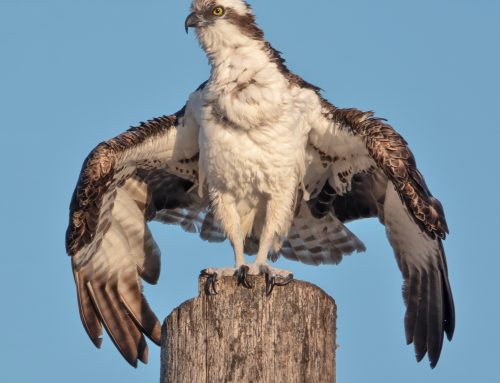
OSPREY-1_33A3964-WEB
Osprey

SWAMP-SPARRPW-2-333A6740-WEB
Swamp Sparrow

SNOWY-EGRET-2-333A5819-WEB
Snowy Egrets
Beautiful photos, Carla! Thank you for sharing them.
Wow, these are really beautiful!!! I’m going to send the link to Barbara.
Great blog and photos, Carla. Glad that you were able to see some lifers while in Texas!
It’s a wonderful collection: the great blue heron looks seriously intent on catching something, and the male great-tailed grackle photo has an Audubonish (not exactly a word) quality to the composition. Thanks for the lovely work!
Love traveling with you. Thanks for sharing. Really appreciate the identifications and your “diary”.
Hi Carla
Love the photos and descriptions of birds, as always. Not so many right now up here in Healdsburg, but tons of rain! Waiting to get into Enso due to some inspections in our part of the Village. Practice helps a lot!
Did see the belted kingfisher often on a riparian walk in Santa Rosa. They are so pretty.
Take good care, warmly, Val
Your narrative speaks to me so that I can visualize your experiences with such clarity!
Thank you for sharing these beautiful photos and words with us!